by Adalmiina Erkkola
Adalmiina Erkkola: The Cinéstesia programme forms a meeting point between cinema, visual arts, and artists’ moving image practices. What do you see happening at those meeting points — whether collisions, frictions or something else — that excites you?
Nour Ouayda: I like your use of the two words collisions and frictions. I would add to it maybe encounters.
For me the distinctions between visual arts, moving image practices and cinema are very vague. One of the distinctions would be in the way that works circulate, rather than what is the content of the work in itself.
It’s so different in terms of what the audience expects; the contract that you have with the audience is different. So how can you play around with this?
An example that I really like to give is that in visual arts or artist moving images exhibition, it’s much more common to watch a short film by itself. In the world of cinema, it’s generally a few shorts put together in a programme. It would be interesting to bring that practice from contemporary art to suggest screenings of just one short work and then take the time to discuss that alone.
This is something that I always find compelling: to bring in stuff that would be generally for the cinema space into other spaces or from the visual arts space into the cinema spaces.
A.E.: How was the experience of working with Erika Balsom, the co-curator of the Cinéstesia screening programme featuring your work? How did you bring all the pieces together?
N.O.: Her suggestion was to curate something together around my works, to highlight both my practice as a filmmaker and film programmer. I think quite quickly we landed on the idea of having on one side the motif of the sea as a starting point, which is the session around one sea, 10 seas. Then another session that would be more around The Secret Garden and ideas of working with speculative fiction, which is part of a research that I’m doing currently.
Once we agreed on that, we both started to bring in suggestions. For me, what was really nice is that we both have our references, our universes, that sometimes intersect and other times diverge. And so we both discovered stuff through what the other was suggesting.
Erika was bringing in, for example, a lot of films from the early twentieth century—so, from the beginning of cinema, with all these works around botany and the technological development of cameras—and at the same time some other works from the 1960s. So that was nice for me to get out of the contemporary moving image bubble that I’ve been working around recently.
A.E.: I wanted to ask about the thin line between fact and fiction. In your work, what does engaging with the realm of fantasy make possible in terms of commenting on the real?
N.O.: I have been currently working on research around these questions called Stranger than Fiction. I focus specifically on the idea of the weird and how it can really transform our relationship from the familiar to the unfamiliar.
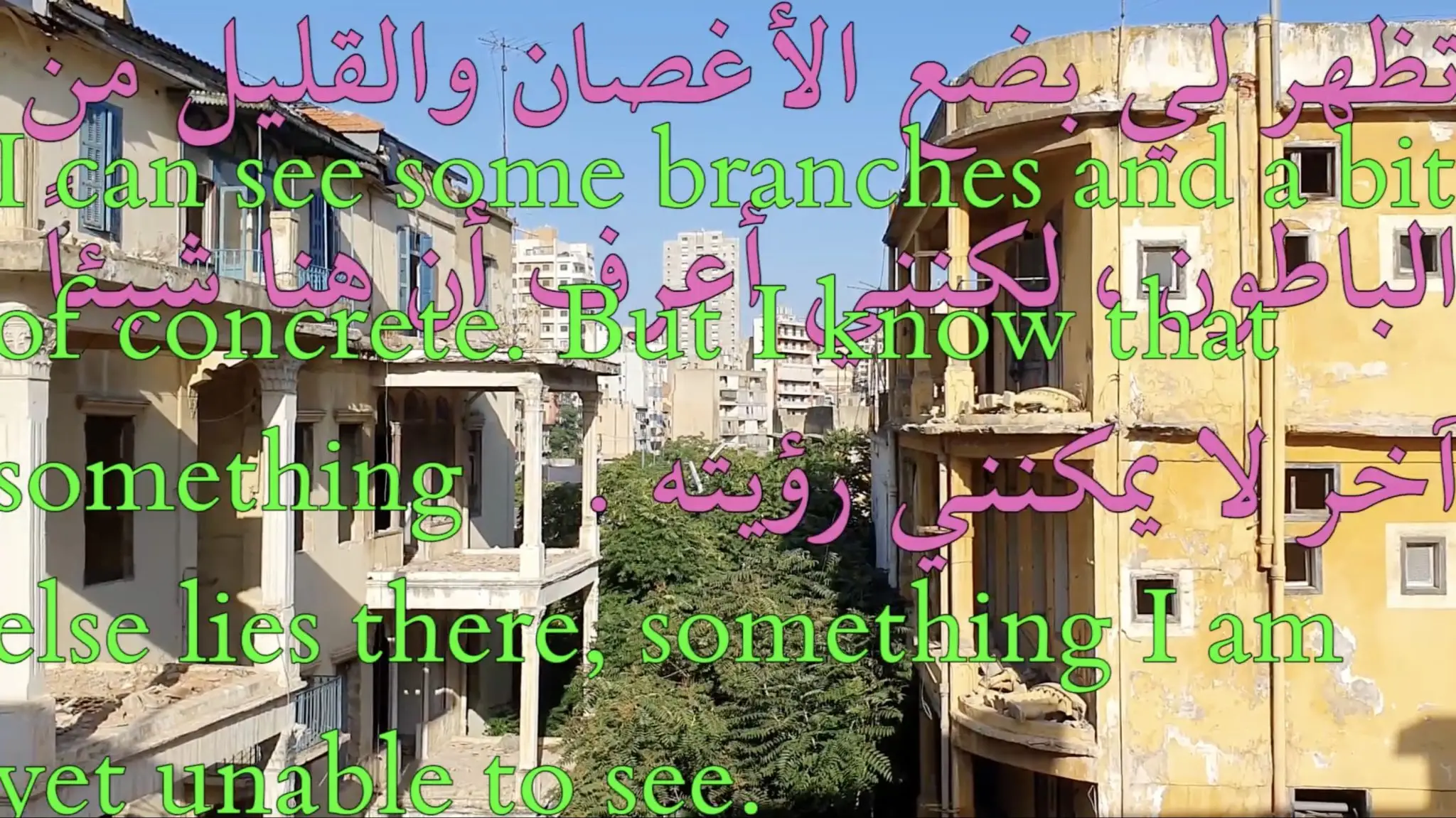
The Secret Garden engages with this in relation to living in Beirut in the past 6 years, since 2019, and all the changes that the city has undergone. It looks at how you document such radical disruptions like wars, ethnic cleansing, explosions that wipe out half of the city, economic crisis that changes your relationship to value and to time, and the pandemic.
I think that the weird can transmit such experiences of alienation and estrangement. It becomes a way of actually documenting a reality that is stranger than fiction, because everything that we’ve been living seems more like science fiction. This is not a new idea, right? This is something that we see in theories of Afrofuturism and all of that.
In this project that is a theoretical, creative and curatorial research I programme The Secret Garden with other films that for me do the same thing — so using the weird to speak about a reality that is veering into strange fiction, but in different territories. So there are films from Indonesia dealing with the Dutch colonial past, films from Haiti or the Azores Islands, or relating to the Black community in the US.
The specificity of all these films is that they use documentary images in the way that they’re not a fully sci-fi where everything is just set up with effects and all of that, but it could just be filming in a landscape that we know very well. But because you have for example a voiceover that’s telling you that we are in a post-apocalyptic landscape, suddenly Beirut becomes a post-apocalyptic city, or actually is revealed to be one.
A.E: As a programmer and as a filmmaker, what do you see being the support that’s needed right now to encourage this kind of work being made, ones which create new imaginaries of storytelling?
N.O.: I’m going to say the obvious thing: financial support.
It’s a big problem, you know, with budget cuts that are happening, where it becomes more and more competitive. If you have more people competing for a smaller or the same pool of money, the idea of what is relevant becomes the defining factor of how something is funded or not.
But also, I think as we’ve been seeing in the last few years, what are the current trends? After October 7th, the approach towards politically engaged art has drastically changed for example. And even in that case, there is a tendency for militantism to become performative or tokenized. So this affects a lot of what is considered to be urgent or relevant art making.
I think that the only way for us to kind of get out of this in a way that is enriching is to keep multiplying the options of what a political work is, for example, of what it means to be politically engaged.
On the other hand, in terms of programming, I think the way that you present films, you talk about them, you describe them, what words you use— is very important. So for me, it’s never presenting an experimental film and saying, “This is a challenging film to watch”, or putting the word “experimental” in the title.
Even when I teach a film programming class, most of the works that I show them are experimental. I don’t necessarily say this. I invite them to go with me without the preconceived idea of how certain cinema should be watched or interacted with.
********
Adalmiina Erkkola, Helsinki-based film programmer interested in the political potential of film and sound.
Nour Ouayda, Beirut-based filmmaker and film programmer, is one of Cinéstesia's Artists in Focus 2026. Her work can be seen in two curated screening programmes on Tuesday 25th August at Kino Tapiola, Espoo – Programme 1 & on Thursday 27th August at Kino Tapiola, Espoo. She will be in conversation about her artistic practice at the Artist Talk on Tuesday 25th August at 12:30 at EMMA – Espoo Museum of Modern Art.
********
Cinéstesia is a new festival strand by Espoo Ciné (21–30 August, 2026) dedicated to the intersections between cinema, visual arts, and artists' moving image. Curated screenings, live cinema performances, archival programmes, and a two-day international seminar. Supported by the Saastamoinen Foundation.
More info: www.espoocine.fi/en/cinestesia