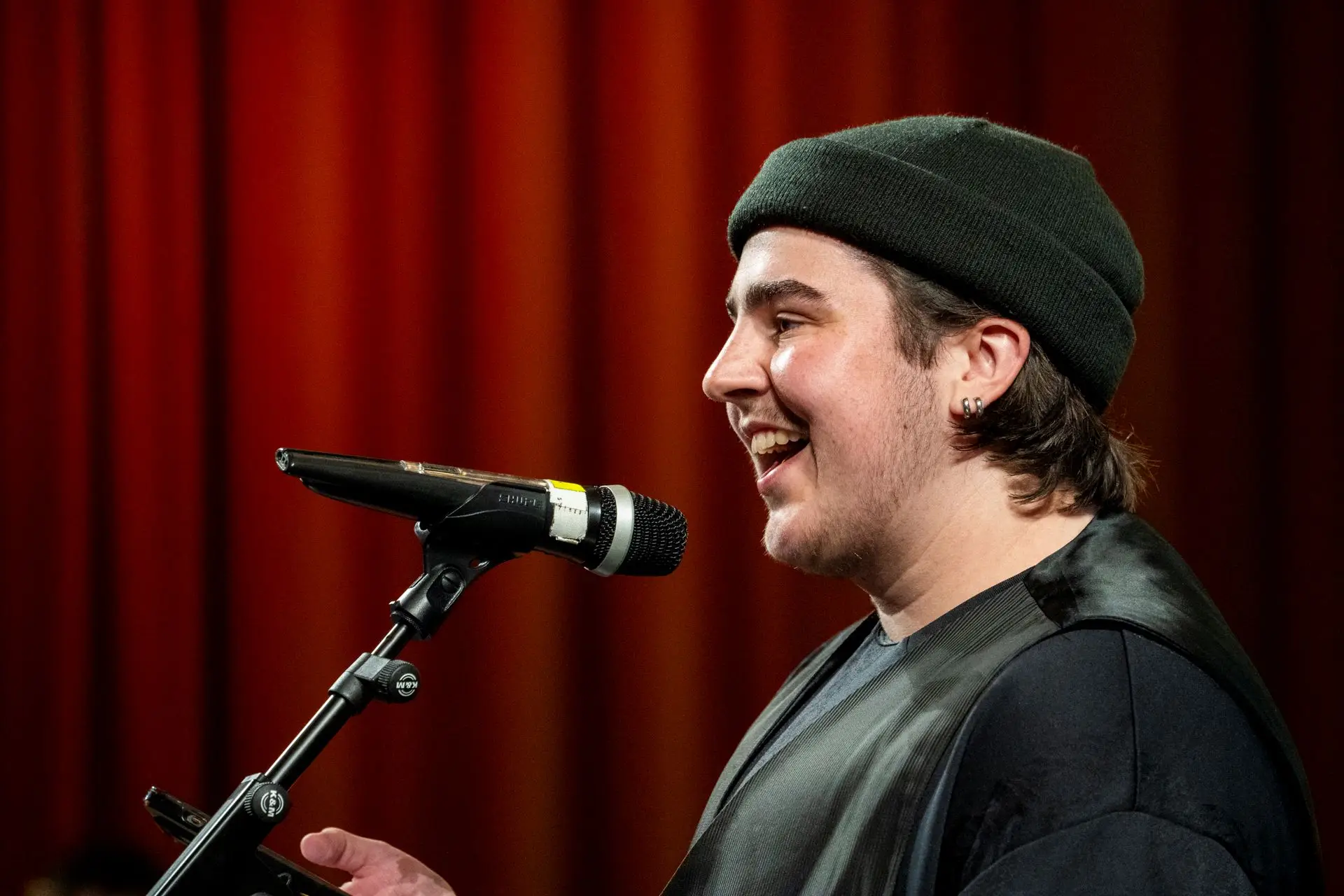
Tobias Holmberg was crowned the winner of the fifth Sinun Ciné idea competition on the festival’s opening day with his idea Näkyvästi piilossa.
The 2026 Sinun Ciné winner Tobias Holmberg is a multidisciplinary artist whose creative projects feed into one another. With a background in theatre and acting, Holmberg began developing the idea for his film debut, the short film Näkyvästi piilossa (meaning Visibly hidden), from a painting depicting both escape and pursuit. In essence, the work deals with fear and moving through the streets at night.
“I ended up applying to Sinun Ciné through Instagram. I was inspired by the idea of an idea competition and by the possibility of working with professional mentors. Mainly, I just wanted to test the waters a little and see what they would say when you send in your own idea.”
Running through the documentary, punctuated by dramatized scenes, are the different gazes directed at the trans protagonist over the course of an ordinary day: the approving looks of a group of men at the workplace who engage in misogynistic humour, as well as the averted, uneasy glances in a nightclub that communicate women’s sense of insecurity.
“In short, it’s a hybrid short film that combines fiction and documentary. I am the protagonist, director and narrator of the documentary myself. At the centre of the film is a trans person whose transition is well underway or complete – and the gazes directed at them: how the gaze of outsiders has changed, among other things, since beginning gender-affirming treatments. One of the central tensions in the film is how my own queer community no longer seems to feel like a place where I belong because I cannot be recognised as trans. There is a related tension around how I recognise other trans men or transmasculine people. The short film follows an ordinary day in the life of a trans person, from morning until night, with certain key moments dramatised through fiction.”
The protagonist’s own gaze searches for community, for a safe place where they can be seen for who they are. This raises the question of how a cis-passing, or cisgender-presenting, transmasculine person wants to be looked at. What does it mean to be seen as oneself? And how can you locate people like yourself through the gaze?
Tobias Holmberg had been contemplating these questions for some time, but Sinun Ciné proved to be an ideal opportunity to begin shaping the work. “What also motivated me to apply, in addition to developing the idea, was the fact that questions of representation had been on my mind for a long time: the feeling that after reaching a certain point – after more advanced gender-affirming treatments and procedures – you no longer see yourself represented anywhere. The representation of trans people has felt monotonous.”
“The film is for trans people who feel like they are caught between two worlds. I hope that this film can be a bridge between these two worlds for us. Or that we can build our own camp somewhere in between.”
For Holmberg, who is venturing into the film world for the first time, the mentoring around professional terminology proved particularly valuable. Through an eventful creative process, he began to understand how concepts used in the audiovisual field can function as tools.
“I learned to structure my thoughts in a way that allows a film professional to understand the idea behind my film. For example, the genre of my film – a hybrid film, meaning one that combines fiction and documentary – emerged through the mentoring process after a long period of discussion and exchange. Through the mentoring, I came to understand that a documentary can include scripted, dramatised scenes. I learned that categorising your work using professional terminology doesn’t mean giving up on the original core idea.”
According to Holmberg, one unexpected aspect was that everyone else in the competition had attended film school, while he was the only self-taught participant. What was pleasantly surprising, however, was the sense of safety and care throughout the competition, which began in the spring.
“More broadly, I was positively surprised by how well-organised the competition was, as well as by the scale of the event. I thought about how wonderful it is that something like this is organised specifically for minorities, for example disabled people, queer people and BIPOC people.”
Holmberg heads towards the new possibilities of autumn armed with many pieces of advice and new insights.
“The most important piece of advice that stayed with me was when my mentor Kirsi told me that this is my first piece of work or experience in the film industry, but it is not my last. This isn’t a moment where everything is at stake. That thought calmed me down and grounded me in the idea that it’s completely OK to be a first-timer. And actually, it’s liberating. I have a tendency to put pressure on myself to be convincing, but through the mentoring I developed in being more open about my idea still being a work in progress.”
Alongside his art school studies, which begin in the autumn, the Sinun Ciné winner’s next goal is to find collaborators to bring the idea of Näkyvästi piilossa to life.
“I want to move the short film forward and look for people who can help bring the work into actual production. I’m looking for production companies, producers, people and networks.”
He is also working on a book that is currently looking for a publisher – and he is interested in new acting roles as well. Holmberg moves fluidly between the arts, and in the spaces between them.
Saarlotta Halme