by Daniel Sundvik
Daniel Sundvik: You mentioned it’s been a long time since you came to Finland, and indeed you have a connection with Finland through one of your movies, A Spell to Ward Off the Darkness [Ben River, Ben Russel. 2013]
Ben Rivers: Yeah, we filmed mostly in 2012, I think, in Finland, Norway and Estonia. The part in Finland was up around Hyrynsalmi. And yeah, it was a really memorable, remarkable experience filming up there.
Feeling the presence of the forest and the lakes, you think you're going into a sort of big, expansive landscape, but actually, it's incredibly claustrophobic in a way. You feel so enclosed by the forests, you really need to get to the lakes in order to breathe sometimes.
And then you come across many abandoned houses where you see that people were living and working. And then obviously, for whatever, probably financial reasons, they've moved on. Because life there is probably quite difficult.
It was a strong, strong experience. And we burnt a little house, which was also a very strong experience.
D.S.: Something you said there, describing the claustrophobia of the forest, reminded me of how your movies often have this mix of something idyllic but also kind of ominous.
B.R.: Yeah, I think it's always been important for me to not depict these places as fully ideal, to the point where they become sort of nostalgic or romantic, that there is always an underlying sense of unease.
I think it's partly because even though I've met and made films with amazing people whose lives are inspiring, at the same time, I have uncertainties about them. I certainly don't want the films to be in any way a kind of propaganda for like, this is the right way to live, everything else is suspect.
I think there's contradictions and flaws with every way you choose to live, but in a sense, I have been looking in my work for how best to live in the world. In some senses, that doesn't necessarily need to be utopia, but it's a search.
And going back to the film we shot in Finland, that shows a person in three different spaces, three different ways of being in the world, that all have a kind of potential, and they also all have questions.
I think it has something to do with my cinematic heritage as well. I grew up really loving horror movies. That was one of the first genres that really excited me and made me want to make films. I wanted to be involved in this thing that really could scare me or, you know, give this feeling of unease, I enjoy that unease.
So even though I'm not making horror films, I'm making films about people who live off in the wilderness, or what have you, I still kind of want to inject those spaces with some of that unease.
D.S.: As you say, many of your films deal with characters living off in the wilderness, or these isolated figures who exist outside of capitalist structures. And yet you're not depicting an ideal. I guess there's no perfect way to live.
B.R.: I don't think there's an answer. There is no easy answer.
And, you know, I spend a lot of time going off to the wilderness or being in nature, but my base is in the middle of London. So I have my own contradictions to deal with, that obviously get echoed in your work.
Mare's Nest has an undertone of unease as well, but that film is also like trying to build a world that has some sort of possibility of hope, in a time where there appears to be very little.
D.S.: To me Mare's Nest feels like it's stripping things back to the basics, with kids from a very innocent starting position trying to search for the right way to live, whatever that might be.
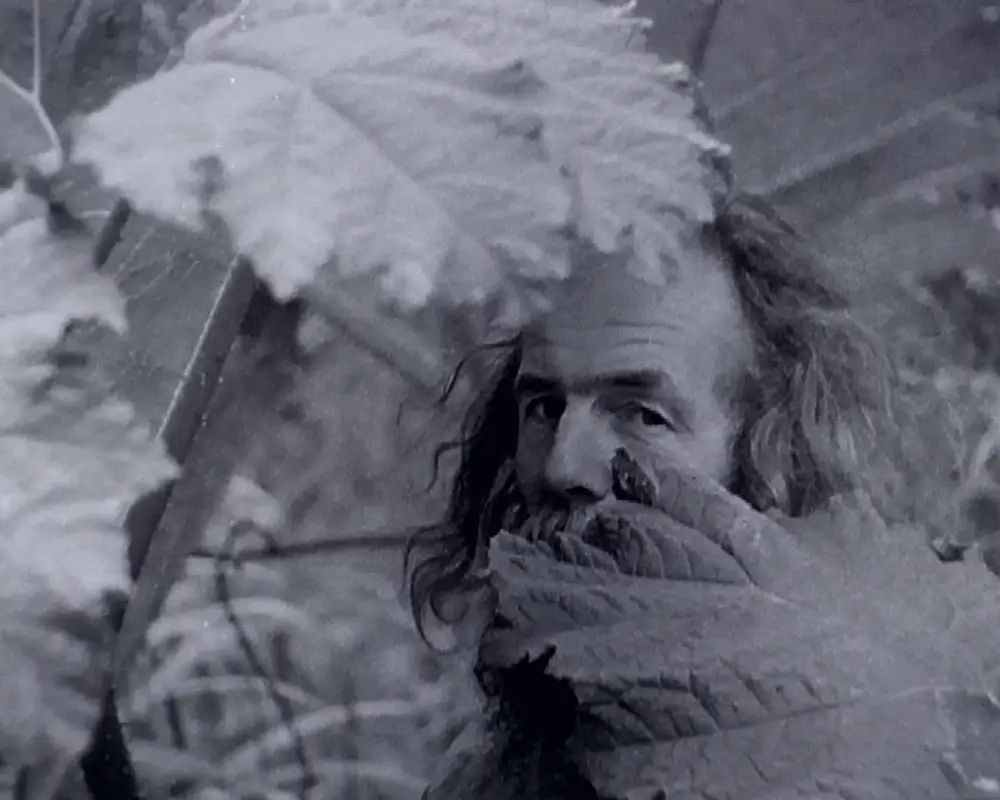
And to me, there’s a connection between the end of Bogancloch with the extraordinary zoom out into space, and the beginning of Mare's Nest, with a zoom in to the origin of the species, a sort of microscopic view, coming back down to the ground. I think a lot of your films could be said to exist within some kind of a Ben Rivers universe. Do you see them that way?
B.R.: I think I do. Yeah. I mean, sometimes it's obviously not conscious. It might not be a deliberate thing that, okay, this leads to this. Sometimes it is, sometimes there are real echoes.
And in a sense between Bogancloch and the Mare's Nest beginning, there was a definite connection in my mind because those two films overlapped in time as well, they were both shot over longer periods of time, so they actually overlapped in the shooting.
And I was thinking about Jake's place in the forest, but also within the universe, within the cosmos. And thinking with Mare's Nest and Moon, okay, if we're going to like, start from scratch, we're going to try and begin again and reinvent what humans can be, then we need to really understand the very beginnings, where we all came from, and be excited about that as well, and understand where it can go wrong.
So, there was a nice kind of connection and, in a way, superficially, they look very different, those films. They're obviously stylistically different, Bogancloch is black and white scope, Mare's Nest is mostly colour. One is with an older person in the forest, and one is with a bunch of kids. But they're both also about a kind of anarchism, and ways of being outside of authority, which I think is such an important thing to question always, but especially now, as we live in an increasingly authoritarian societies.
So as a filmmaker, or whatever kind of artist you are, you have your obsessions, and they repeat, and you deal with them in different ways, hopefully, with each different film.
But there's always going to be these recurring motifs or themes. And it's interesting to look back on a body of work as well, and see these connections that are also unconscious, when other people put your films together, because they've seen a connection that you have no conscious idea about.
D.S.: That leads me on to a question about curation. As you know, Cinéstesia is being curated by film scholar and critic Erika Balsom. Alongside championing artists’ film and video, the curatorial work is also a strong part of what is being highlighted by the programme.
You yourself worked with Erika as part of The Machine That Kills Bad People at the ICA in London. Could you talk a bit about your own work as a curator, and how that fits in alongside your work as an artist?
B.R.: It's in a way quite a big question, because it's three decades of work now. But yeah, initially, when I was 16, I went to art school, because I wanted to be involved in horror films, making prosthetics and special effects, stuff like that. And then you go to art school, and you get introduced to all this amazing stuff.
And, you know, your mind explodes and you find your life going in a different direction. And then at my art school, I started running a film club, just showing films once a week, and just really enjoyed it, like, both on a selfish basis, because I could order films that I really wanted to see, but also that a community built around this, albeit a small community.
And then, when I left art school and moved to Brighton, I met the right people. And we started a little cinema called Brighton Cinematheque. And, you know, having never learned about making films, art school didn't really teach me anything, running a cinema was my film school, it was how I learned what cinema is.
And our programming was extremely eclectic, it wasn't just experimental artist films, it was also silent films, trash, horror, sci-fi, classics, it was just such a mishmash of everything, and from worldwide cinema. So I was just sort of filling my head with this. And that excitement of not only watching this stuff, but sharing it, has just continued.
So if ever I have an opportunity, I want to carry on doing that, you know, I'm not one of those filmmakers who says they don't watch other people's films, I'm a cinephile, I like cinema, of all kinds. And so, sometimes it can be just like a one off thing, you get invited to a festival or a retrospective or something, and they give you carte blanche, but doing something like The Machine That Kills Bad People, where we can do something a lot more in depth, over eight years, is really amazing.
And because there were four of us doing it, we've all got different knowledge bases and different things to put into the pot. But with one kind of goal, which is to show amazing and not seen enough cinema. And in this case, it was also films only made by women, which we never advertised, and incredibly, a lot of people didn't notice.
D.S.: I hadn't noticed.
B.R.: Yeah, that was something we decided at the beginning, because we thought, we don't want to make it a women's film club, because in a way that will probably ostracise some people. So we're just gonna do this film club with this title.
And it's always a short and a feature. And, you know, they're just amazing films, and a lot of the time, hard to see in the cinema. And it’s the good thing about doing a season, a series over a long period of time is that you grow a loyal audience.
And by a certain point, people will just come and see what we put on. And that's the hope, that you have a community who are all eager and interested, even if like, maybe one film, they might not like, but they'll still come back to the next one, because they know that there's a certain kind of level of excellence.
But for me, still a lot of the most exciting nights for me were ones where, because we would pick the films all together, sometimes I hadn't seen the film before. And, I get a lot of excitement about being introduced to some film that I'd not seen until that point in my life.
So it's hard to say how it feeds in, because at the same time, when I'm making my own films, I really kind of try not to think about any other films, I find it distracting, thinking about other people's work.
Occasionally, somebody will pop in, but more as a kind of courage, like Pasolini pops into my head sometimes if I'm feeling some self doubt, you know? Or some worry about just a scene or an idea.
And then you think about some of these people that mean a lot to you that showed no compromise, you know? So sometimes you just reach out to them.
But I think the other good thing about really like soaking my brain full of films, especially during the Cinematheque years, was that it was so much and so eclectic that it would be impossible to be overly influenced by one type of cinema.
So that's partly why, because we didn't want to be put in a box as a cinema, I've also never wanted to be put in a box for my filmmaking. People put you in them anyway, it's something that happens, whether you want it or not. But I've tried to not be pinned down too much.
D.S.: It sounds like the kind of courage you're looking for from other films is the courage to have the freedom to not compromise, to not pin yourself down, to to have that boldness and bravery. And I think that's the same instinct in the curatorial work as well.
A lot of that The Machine That Kills Bad People Programme was bold, the type of stuff that, unless you can really build that community, it's difficult to imagine selling enough tickets to keep the programme going. So that also requires a degree of boldness and freedom and a lack of compromise, a belief in the level of quality of your work.
B.R.: But then it becomes a boldness on the part of the audience as well to believe in you as a group of curators.
And also a boldness on the part of the ICA to keep supporting it.
But we did get really good audiences. I mean, it was really popular. Now I need to find a new platform.
D.S.: Yes, it's come to an end now.
B.R.: We brought it to an end with the book. It seemed like a nice way to round it off.
D.S.: To circle back to the filmmaking - I wanted to ask about the music. In Mare's Nest in particular, there is a scene with a child singing, who reminded me of a young Daniel Johnston, and then the scene of a child in the car listening to Frustration. Could you talk a bit about how you work with music?
B.R.: Yeah, the Frustration track came pretty early in the writing, actually, it just came on by chance as songs sometimes do. And I just thought, oh, this is so perfect. The lyrics of it, you know, I have so many questions, I don't have any answers. And I thought, this is the sort of filmmaking I like as well, that gives me so many questions, and not necessarily any answers. I'm not necessarily looking for that. And I thought this would be an amazing track.
So in the writing, she was going to find the car in the desert. And there was going to be a tape in the car, and she was going to play it while she was driving. But that changed just before I filmed it, because when we were looking for the car for the final scene in the desert, we were just stopping in cafes and asking people, random people if they had an old car. And we stopped in this one cafe, and I saw that guy, his name was Derek, this kid with amazing hair and face. And I thought, I need him in the film. So then the scene shifted to him listening to that track, which I just thought was nice with his expression, which is so hard to read, it's so mysterious. And he's kind of very gently rocking out to this song, which has a kind of energy to it.
And often, when I'm making a film, I start putting together a playlist as well. I don't imagine those songs necessarily being in the film, but they're kind of part of the mood, they help me think about it.
So if I'm going for a long drive, and I'm thinking about the film, and I put the playlist on, and it somehow helps me get in that world, the energy. Like on the playlist, there was a Laurie Anderson song, the one where she sings the line, golden cities. And that did end up as one of the intertitles, when they go to the underground.
And then Gene, who plays the song that is a bit like a Daniel Johnston, I agree. He wrote that song himself. And again, that was sort of a chance. I'd filmed a lot of the film, and a good friend of mine said, you're making a film with children, you should really meet this kid, Gene. He's really eccentric. He likes to choose his own outfits, and he plays music. And so his parents sent me a couple of his songs, and one of the songs was that one. And I thought he should sing this to Moon, it’s such a beautiful and caring song. It's about kind of going inside someone's mind to like, try and help them figure out what they're worried about. So sometimes, if you make a film freely enough, you get these offerings from the universe, and then you find a way to put them in.
And then also, with the minotaur section, I just thought that if those kids had made the film and they'd made it silent, the best way that they would accompany it would be with drums. So we made this kind of janky drum kit and I asked Valentina Magaletti, who's an amazing percussionist, if we could use her drumming for that part. Which, you know, she's absolutely brilliant. So that's a really key part, I think, of that part of the film.
But I don't really like to have composed soundtracks. I prefer finding things that feel like they might be part of the space.
D.S.: I also wanted to ask about the materiality and tactility of your films, about how when working with film you allow for example scratches or flare-ups on the film, particularly for example in that minotaur sequence. That materiality has been pretty consistent across all of your films.
B.R.: Yeah, it sort of originated because I was at art school and I didn't really know what I was doing. And at that time, digital was still in early stages and was not looking very nice. So it was kind of a choice between Mini DV or Super 8.
And I went to Super 8 because I like the physicality of it. I was also making stuff at art school, physical objects and prints, so Super 8 was the obvious thing to go to.
And then the next obvious thing after Super 8 was 16mm. And then I started hand processing, partly because at the beginning, it was just a way to make it cheaper, to save on lab costs. But then I started to see some of the really beautiful results you could get doing hand processing and some of the added adventure to the making of a film, the excitement of uncertainty and accident.
So it's not just aesthetics, it's also the feeling of knowing that you've got this limited amount of time on a film reel, over three minutes or 12 minutes. And when you press record, there's no going back. This is a physical thing that's happening, you can't record over it, there's a limited amount of time. And so there's something about the way you consciously decide to film, which is definitely a different thing going on.
And I guess I also liked the fact that you don't even see what you've shot straight away. You know, I go up there for a week, 10 days, film a bunch of rolls of film, and I wouldn't see anything. And then I'd get home, and then it would probably take another week or two processing, and then getting it scanned.
So there's this gap in time between filming and actually seeing your material for the first time. And it's such an exciting moment, which is something you don't get with digital. It's kind of hard to put your finger on why that's exciting, because it's also full of uncertainty, and sometimes disappointment. You know, when you watch your rushes back for the first time, you think, oh, God, I missed it. Or, you know, this didn't turn out the way that I thought it would. But then you discover other things.
Yeah, so I think the physicality of it has always meant a lot to me, because it's also related to the kinds of places where I like to film as well, which are physical.
With Mare's Nest, I explained the film to all the kids. I showed what happens, how long a roll of film was. And they could see me, I'd be filming and then I'd say okay I need to go and change the camera, and they'd see my hands going into the magic tent and then coming out with a new magazine, so they were really aware of the importance of this time, when I'm filming, and they took it seriously. Whereas if I'd been shooting with digital, I think it would have been different, because they're so used to filming on their phones and stuff like that.
DS: Does it add a sense of ritual perhaps as well? It strikes me in Mare’s Nest how one of the things that the kids decide to do with the world and time is to perform rituals, and one of their rituals is to make a movie. The process you’re describing sounds ritualistic in a way.
BR: It is, it is ritualistic, and the ritual is to create magic.
********
Interview by Daniel Sundvik, Founder of BKS Cinema, a distribution company aiming to bring the most distinctive arthouse films to Finnish audiences.
Ben Rivers, London-based experimental filmmaker working at the threshold of documentary and fiction. Winner of multiple international awards including the Tiger Award (IFFR) and the Pardo Verde for Mare's Nest (Locarno, 2025).
********
Cinéstesia is a new festival strand by Espoo Ciné (21–30 August, 2026) dedicated to the intersections between cinema, visual arts, and artists' moving image. Curated screenings, live cinema performances, archival programmes, and a two-day international seminar. Supported by the Saastamoinen Foundation.
More info: www.espoocine.fi/en/cinestesia